
What Battery Size Do I Need for My Home in Pakistan? (2026 Guide)
Every year, thousands of Pakistani homeowners invest in a solar system and then get the battery decision completely wrong. Some buy too little and run out of power halfway through a load-shedding window. Others overbuy and spend lakhs on capacity they never use. Choosing the right battery size for home in Pakistan is not guesswork – it is a straightforward calculation once you know the three numbers that matter.
This guide walks you through those numbers step by step. You will know your required kWh by the end, understand why LFP lithium batteries are the right technology for Pakistan’s climate, and see exactly how the Volnex Alpha Series maps onto different Pakistani home sizes.
Why Getting Battery Size Right Matters More Than Brand
Most buyers walk into a solar market asking “which battery is best?” The better question is “which battery is right for my specific load and my specific load-shedding window?”
A battery that is too small will:
- Run out of power mid-outage, leaving you back in the dark
- Be discharged too deeply on a daily basis, which shortens its life
- Force you to keep critical appliances off – defeating the purpose
A battery that is too large will:
- Sit at high charge most of the time, which is not how lithium batteries stay healthy long-term
- Cost you significantly more than what your home actually needs
Correct sizing protects your investment, maximises cycle life, and gives you exactly the backup duration your family needs – nothing more, nothing less.
Step 1 – List the Appliances You Need to Run During Load Shedding
Start here. Do not size for every appliance in your home. Size for the appliances you genuinely need during an outage: fans, lights, fridge, router, and in many households, at least one inverter AC.
Use the reference table below, which reflects real-world wattages for appliances commonly found in Pakistani homes.
| Appliance | Typical Running Watts | Notes |
|---|---|---|
| Ceiling fan | 70–80 W | Standard three-blade domestic fan |
| LED bulb (9W) | 9 W | Per bulb |
| Tube light (LED) | 18 W | Per fitting |
| Refrigerator (medium) | 120–180 W | Average running draw; startup surge is 2–3× |
| Wi-Fi router | 8–12 W | Always-on during outage |
| LED TV (43–55 inch) | 80–120 W | Varies by screen size and brand |
| Laptop | 45–65 W | Per device |
| Phone charger | 5–20 W | Per charger in use |
| 1.5-ton inverter AC | 1,100–1,400 W | Running; startup surge up to 3,000 W |
| Water motor (0.5 HP) | 370–400 W | Typically run in short bursts |
| Washing machine | 400–600 W | Usually not a load-shedding priority |
Practical tip: List only what you will actually run during a power cut. For most urban families, a realistic essential load looks like: 4 ceiling fans, 8 LED bulbs, 1 refrigerator, 1 Wi-Fi router, and 1 LED TV. That totals roughly 600–700 watts. If you include one 1.5-ton inverter AC, total load climbs to 1,700–2,100 watts.
Add up your total watts. Write that number down – it is your peak running load (W).
Step 2 – Decide How Many Hours of Backup You Need
Pakistan’s load-shedding reality varies significantly by location, distribution company, and season. Use the table below as a planning baseline.
| Area Type | Typical Daily Load Shedding | Recommended Planning Hours |
|---|---|---|
| Karachi (K-Electric) | 2–6 hours | 6–8 hours (summer peak) |
| Lahore / LESCO | 4–8 hours | 8–10 hours (summer) |
| Faisalabad / FESCO | 6–10 hours | 10–12 hours |
| Interior Sindh / Punjab | 10–18 hours | Full-day planning required |
The golden rule: plan for the worst day of summer, not the average day. If your area can hit 10-hour outages in July, size for 10 hours – not for the 4-hour outages of October.
Write down your required backup hours (h).
Step 3 – Understand Depth of Discharge (DOD)
Depth of Discharge is the percentage of a battery’s total capacity you can use before you must stop discharging it. Going past the rated DOD shortens the battery’s cycle life significantly.
Lead-acid batteries (tubular/AGM): maximum safe DOD is 50%. So a 10 kWh lead-acid bank only gives you 5 kWh of usable energy.
LFP (LiFePO4) lithium batteries: safe DOD is 80–90%+. A 10 kWh LFP bank gives you 8–9 kWh of real usable energy.
This is one of the most important reasons lithium wins for residential solar storage in Pakistan. You need a physically smaller, lighter battery to get the same usable backup.
The Volnex Alpha 5.12, for example, is rated at ≥8,000 cycles at 90% DOD – meaning it is designed to be discharged deeply every single day and still last well over a decade.
For your calculation, use DOD = 0.90 for any LFP lithium battery.
Step 4 – Account for Inverter Efficiency
Your hybrid inverter is not 100% efficient. When energy moves from battery to AC output, some is lost as heat. Most quality hybrid inverters in Pakistan run at 85–92% efficiency.
For a conservative and accurate calculation, use inverter efficiency = 0.90 (90%).
If you skip this step, your system will come up short every time the load-shedding window stretches beyond your estimate – a problem that catches many buyers by surprise.
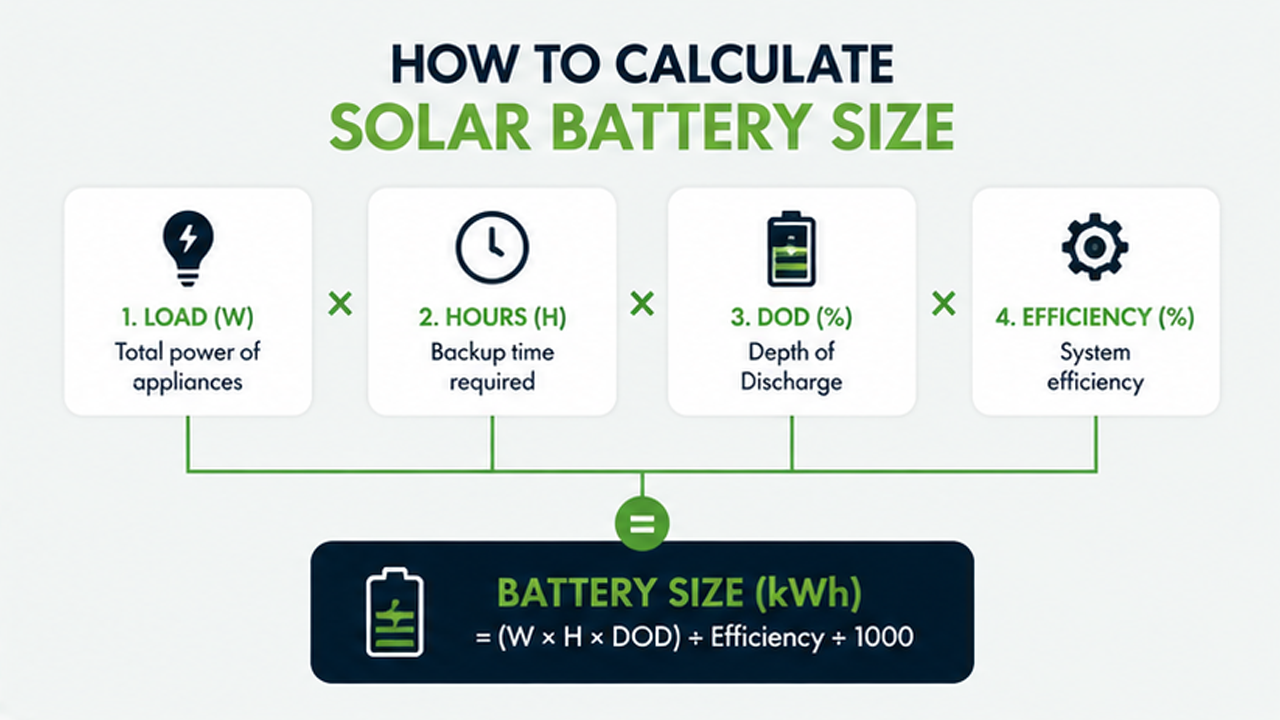
The Complete kWh Sizing Formula
With your four numbers ready, here is the formula:
Required Battery kWh = (Total Load W × Backup Hours) ÷ (1,000 × DOD × Inverter Efficiency)
This gives you the nominal battery capacity you need to shop for.
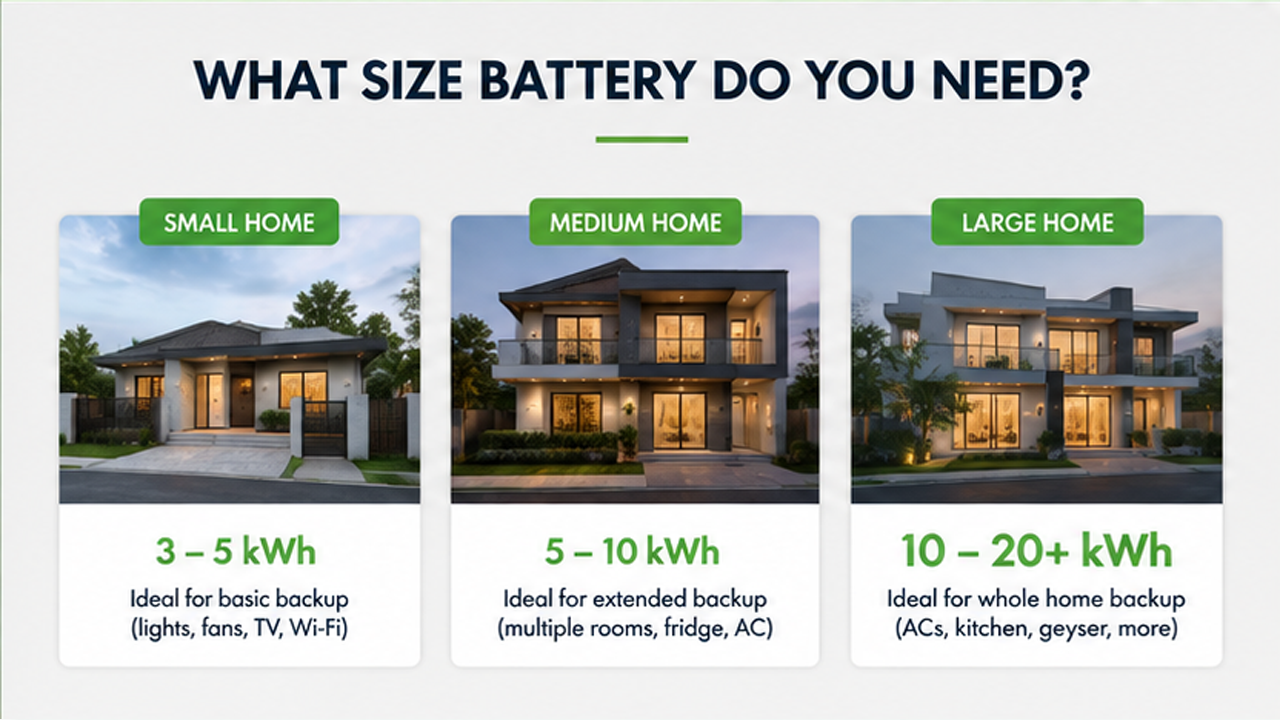
Three Real Pakistani Home Scenarios
Scenario A – Small Apartment / 2–3 Marla Home
Appliances during outage: 2 ceiling fans, 6 LED bulbs, 1 refrigerator, 1 Wi-Fi router, 1 LED TV Total load: ~450 W Backup needed: 8 hours
Required kWh = (450 × 8) ÷ (1,000 × 0.90 × 0.90)
             = 3,600 ÷ 810
             = 4.44 kWh nominal
The Volnex Alpha 5.12 (5.12 kWh) fits this scenario with comfortable headroom. It runs the essential load for 8–9 hours and still has reserve capacity to protect cycle life.
Scenario B – Medium Home / 5–8 Marla
Appliances during outage: 4 ceiling fans, 8 LED bulbs, 1 refrigerator, 1 Wi-Fi router, 1 LED TV, 1 laptop Total load: ~650 W Backup needed: 10 hours
Required kWh = (650 × 10) ÷ (1,000 × 0.90 × 0.90)
             = 6,500 ÷ 810
             = 8.02 kWh nominal
The Volnex Alpha 10.49 is the right fit here. It covers this load comfortably for 10+ hours on a daily cycle.
Scenario C – Larger Home / 10 Marla+ or 1.5-Ton AC Included
Appliances during outage: 4 ceiling fans, 10 LED bulbs, 1 refrigerator, 1 Wi-Fi router, 1 LED TV, 1 × 1.5-ton inverter AC Total load: ~1,800 W Backup needed: 8 hours
Required kWh = (1,800 × 8) ÷ (1,000 × 0.90 × 0.90)
             = 14,400 ÷ 810
             = 17.77 kWh nominal
For a home that needs to run an AC through long load-shedding windows, the Volnex Alpha 16 is the starting point, or a pair of Alpha 10.49 units running in parallel. Discuss your exact scenario with a Volnex dealer for precise sizing.
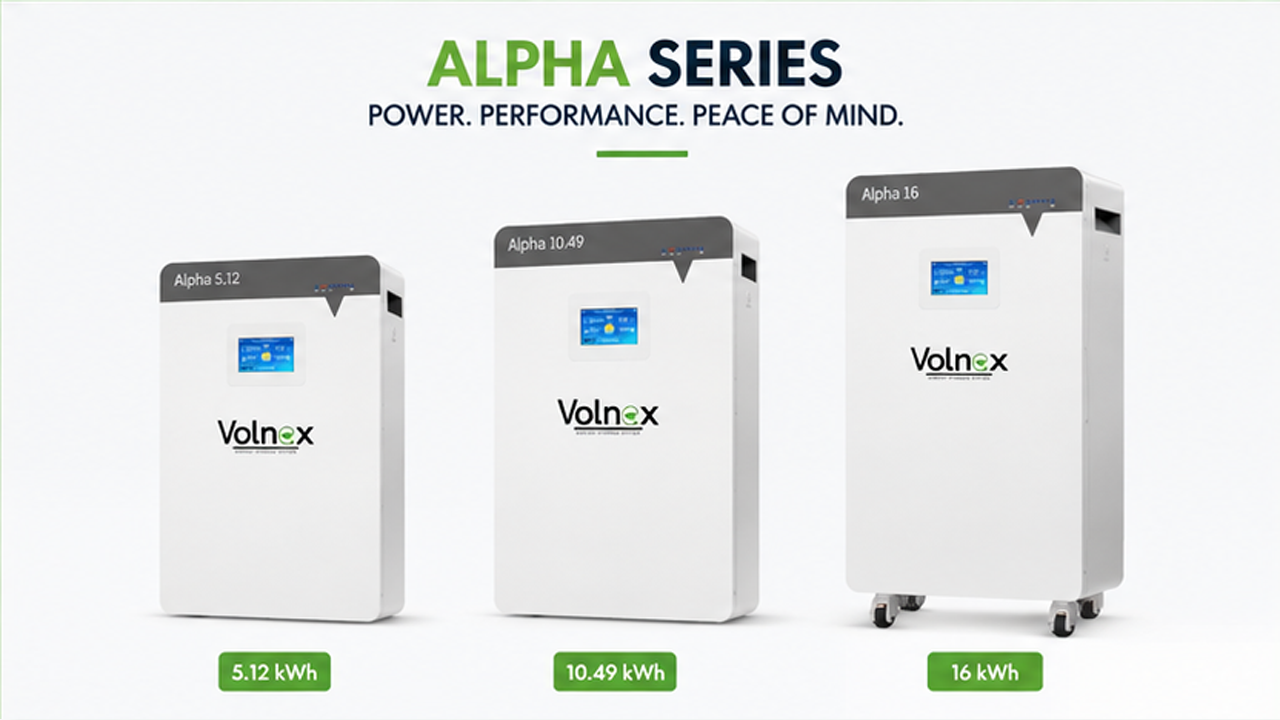
Which Volnex Alpha Battery Fits Your Home?
Understanding the right battery size for home in Pakistan is the first step. Choosing the right model within the Volnex Alpha Series is the second.
Here is how the three residential models compare:
| Model | Nominal Capacity | Cell Capacity | Best Suited For | Max Parallel |
|---|---|---|---|---|
| Alpha 5.12 | 5.12 kWh | 100 Ah | Small apartments, essential-only loads | Up to 15 units |
| Alpha 10.49 | 10.49 kWh | LFP Class A | Medium homes, no AC or short AC use | Parallel supported |
| Alpha 16 | ~16 kWh | 314 Ah | Larger homes, extended AC backup | Parallel supported |
All three models share the same LFP/LiFePO4 chemistry and the same core feature set: intelligent BMS with real-time voltage, temperature, and SOC monitoring; Touch LCD display; one-button start/stop; automatic aerosol fire suppression (on applicable models); and a 10-year warranty (5 years product + 5 years service).
The Alpha 5.12 has a verified cycle life of ≥8,000 cycles at 90% DOD – one of the strongest longevity specs available in the residential battery category in Pakistan today.
Volnex is not a commodity battery brand. The company operates with in-house R&D, a testing lab, a service network across Pakistan, and technical support accessible by phone, email, and WhatsApp. When you choose a Volnex Alpha battery, you are not just buying a product – you are buying into a technical support ecosystem designed for the long term. Learn more about Volnex.
Should You Start Small and Expand Later?
Yes – if your budget is tight today but your load may grow, this is a realistic strategy with Volnex.
The Alpha 5.12 supports up to 15 units in parallel. This means you can install one unit now and expand your storage as your household needs grow, as your solar array grows, or as your budget allows – without replacing any existing hardware.
Similarly, the Alpha 10.49 and Alpha 16 support parallel configuration. Plan your initial installation with expansion in mind: make sure your hybrid inverter, cabling, and DB box are sized to accommodate the future total capacity, not just the first unit.
One important note: battery sizing questions for large parallel setups should always be validated by your solar battery installer or a Volnex technical representative. Confirm inverter compatibility with the specific Alpha model before purchase.
If your project is commercial or industrial in scale, the Volnex Alpha Series is not the right starting point. You will want to explore the HV Sun or HV Pro Series – read our guide on Low Voltage vs High Voltage ESS to understand which architecture applies to your project.
Common Mistakes Pakistani Buyers Make When Choosing a Battery
1. Buying by price per kWh without checking DOD. A lead-acid battery at 50% DOD and a lithium battery at 90% DOD are not comparable by price alone. Compare usable kWh and total cycle life.
2. Sizing for today’s load, not tomorrow’s. Your load will grow. If you add an AC next summer or a second refrigerator, your current battery may fall short. Build in 20% headroom.
3. Ignoring inverter efficiency. A 5 kWh battery does not deliver 5 kWh to your home. Inverter losses and DOD limits reduce the real-world usable figure. Use the formula – do not eyeball it.
4. Buying a battery without checking inverter compatibility. A battery must communicate with your inverter via CAN or RS485 protocol for safe, optimised operation. Never assume compatibility – verify before purchase.
5. Assuming all lithium batteries are equal. Cell quality, BMS design, fire protection, and after-sales support vary enormously. Volnex uses Grade A/Class A LFP cells with 100% capacity testing before dispatch, which directly impacts real-world performance and longevity.
Frequently Asked Questions
What is the right battery size for home in Pakistan?
It depends on your load and required backup hours. A small apartment with fans, fridge, and lights needs roughly 4–5 kWh nominal capacity. A medium home needing 8–10 hours backup typically needs 8–11 kWh. A home running an AC through long load-shedding windows may need 16 kWh or more. Use the formula in this guide to calculate your exact figure.
Is 5 kWh enough for load shedding in Pakistan?
For essential loads without an AC – fans, lights, fridge, router, TV – a 5 kWh LFP battery like the Volnex Alpha 5.12 will comfortably cover 8–9 hours. If your load-shedding window regularly exceeds that or you plan to run an AC, step up to the Alpha 10.49 or Alpha 16.
How long will a 5.12 kWh battery last during load shedding?
At 600 W total load with 90% DOD and 90% inverter efficiency, usable energy is roughly 4.14 kWh, giving you approximately 6.9 hours of backup. Reduce your load (switch off the TV or one fan) and you can comfortably reach 8 hours.
How many years does a lithium battery last in Pakistan?
A quality LFP battery rated for 6,000–8,000 cycles, cycled once daily, lasts 16–22 years on paper. Real-world lifespan in Pakistan’s climate depends heavily on operating temperature and installation quality. The Volnex Alpha 5.12 is rated at ≥8,000 cycles at 90% DOD and backed by a 10-year warranty.
Can I add more batteries later if I need more backup?
Yes. The Volnex Alpha 5.12 supports up to 15 units in parallel, and the Alpha 10.49 and Alpha 16 also support parallel expansion. Always confirm that your inverter and installation design support the expanded configuration before adding units.
What is the difference between kW and kWh for a battery?
kW is power – how many appliances the battery can run at once. kWh is energy – how long it can run them. A 5.12 kWh battery with a 100 A / 51.2 V rating delivers approximately 5.12 kW for 1 hour, or 1.28 kW for 4 hours. Always size for both your peak load (kW) and your backup duration (kWh).
Ready to Choose? Explore the Volnex Alpha Series
Calculating the right battery size for home in Pakistan is the most important step in any solar-storage project. With the formula and examples in this guide, you now have the numbers you need to have a meaningful conversation with your installer or dealer – not just a gut feeling about which box looks right.
The Volnex Alpha Series is designed specifically for residential solar battery in Pakistan’s climate: LFP chemistry that handles the heat, Grade A cells tested before dispatch, an intelligent BMS that protects your investment, and a 10-year warranty that gives you genuine long-term security.
Explore the full range and request a quote through your nearest Volnex dealer:
- Alpha 5.12 – Essential Load Backup
- Alpha 10.49 – Medium Home Backup
- Alpha 16 – Extended Backup for Larger Homes
- Full Low Voltage Battery Range
Not sure which model is right for your load? Contact the Volnex team or reach out via WhatsApp for guidance from a technical specialist before you buy.
Volnex – The Brand Behind The Power. Established 2021, serving Pakistan with lithium energy storage solutions for residential, commercial, and industrial applications.