

What Is a BMS (Battery Management System)? Complete Guide for Solar Batteries in Pakistan
If you own a solar battery system in Pakistan — or you’re planning to buy one — you’ve almost certainly seen the term BMS battery management system on a product page or datasheet.
But what exactly does a BMS do? Why does it matter? And is every BMS the same?
This guide answers all of it: what a battery management system is, how it protects your battery, why it’s especially critical in Pakistan’s climate and load-shedding cycles, and exactly how Volnex’s intelligent BMS works across every product in the lineup.
What Is a BMS (Battery Management System)?
A BMS (Battery Management System) is an electronic control circuit that monitors, protects, and optimizes a rechargeable battery pack in real time.
Think of it as the brain of your solar battery.
Without a BMS, a lithium battery — no matter how high-quality its cells are — is exposed to the conditions that destroy it fastest: overcharging, over-discharging, temperature extremes, unbalanced cells, and short circuits. With an intelligent BMS, every one of those conditions is detected and corrected automatically, without any action from you.
According to Ansys, a battery management system is technology dedicated to the oversight of a battery pack by monitoring, protecting, and estimating the operational state of the battery at all times.
Wikipedia defines a BMS as any electronic system that manages a rechargeable battery by facilitating its safe usage and extending its lifespan.

How Does a BMS Work?
A BMS works by continuously reading real-time data from every cell inside the battery pack — voltage, current, and temperature — and comparing that data against the manufacturer’s safe operating limits.
When any parameter approaches or exceeds its limit, the BMS either:
- Sends an alarm to the display or monitoring app
- Cuts off the charge or discharge circuit automatically
- Initiates corrective action such as cell balancing
This process happens thousands of times per second, invisibly, every time your battery is in operation.
Key Functions of a Battery Management System
1. Voltage Monitoring
The BMS measures the voltage of each individual cell in the battery pack. If any cell charges above or discharges below its safe voltage range, the BMS intervenes immediately.
In LFP (Lithium Iron Phosphate) batteries — the technology Volnex uses across all its product lines — the safe cell voltage range is precisely defined. Even small deviations, if unmanaged, cause permanent capacity loss.
2. Temperature Monitoring
Pakistan’s climate creates real battery stress. Karachi’s coastal humidity, Punjab’s summer heat regularly exceeding 45°C, and rapid day-to-night temperature swings all put continuous pressure on battery cells.
The BMS monitors temperature at the cell level, continuously. If the battery gets too hot during charging or discharging, the BMS slows or stops operation before thermal damage occurs.
Volnex’s Alpha Series, for example, operates at charge temperatures of 0°C to 50°C and discharge temperatures of -15°C to 50°C. The BMS enforces these limits automatically — no manual setting required.
3. State of Charge (SOC) Monitoring
SOC is the “fuel gauge” of your battery — it tells you exactly how much energy is stored at any given moment.
Without accurate SOC monitoring, a battery can be discharged too deeply (damaging cells permanently) or overcharged (causing heat and accelerated degradation). Volnex batteries display live SOC via a touch LCD screen and LED indicators, all powered by BMS data in real time.

4. Overcharge Protection
Overcharging is one of the fastest ways to destroy a lithium battery. When a battery is pushed past its maximum safe charge level, excess energy triggers a chemical reaction inside the cells that generates dangerous heat and, in severe cases, can cause swelling or fire.
The BMS detects when the battery has reached its safe charge limit and stops the charging process — even if the solar inverter is still pushing power.
5. Over-Discharge Protection
Discharging a lithium battery below its minimum safe voltage permanently damages the cells and reduces total capacity — often irreversibly.
The BMS cuts off the discharge circuit before the battery reaches this threshold, protecting usable capacity for the lifetime of the system.
6. Short Circuit Protection
In the event of a wiring fault or equipment failure, a short circuit can draw an enormous surge of current from the battery almost instantaneously — enough to cause fire or explosion.
The BMS detects abnormal current spikes and disconnects the battery within milliseconds.
7. Cell Balancing
A battery pack consists of multiple individual cells. Over time, cells naturally develop slightly different capacities — some fill faster, some drain faster. Left unmanaged, this imbalance reduces the total effective capacity of the entire pack.
Cell balancing is the BMS function that equalizes charge levels across every cell, ensuring the full rated capacity of the battery remains available for as long as possible.

Why BMS Matters More in Pakistan
Pakistan’s solar battery market is one of the fastest-growing in the world. The country imported over 4.6 GWh of battery storage in 2025 alone — and with that growth has come a flood of cheap products, many with inadequate or no proper BMS protection.
In Pakistan specifically, the BMS is critical for three reasons:
1. Load shedding creates heavy, frequent cycling. Batteries in Pakistan are cycled more intensively than in markets with a stable grid. A BMS that enforces proper Depth of Discharge (DOD) limits — such as Volnex’s recommended 95% DOD on the HV Sun Series — directly extends battery life over years of daily use.
2. Temperature extremes are severe. Without temperature monitoring and protection, a battery installed in a hot rooftop enclosure or a poorly ventilated room in Karachi’s summer can degrade in months. The BMS is the only thing standing between your battery and accelerated thermal degradation.
3. Inverter compatibility requires communication. Pakistan’s solar ecosystem uses a wide range of hybrid inverters. A proper BMS communicates with the inverter via CAN or RS485 protocols — coordinating safe charging and discharging automatically. Without this communication link, the inverter operates blind.
A battery without a certified, intelligent BMS is not a solar storage investment. It is a risk.
What Makes an “Intelligent BMS” Different?
Not all BMS systems are equal. Many cheap lithium batteries entering the Pakistani market carry only a basic BMS — enough to meet a minimum specification on paper, but far short of what’s needed for safe, long-term solar storage.
Here’s how an intelligent BMS like Volnex’s compares:
| Feature | Basic BMS | Intelligent BMS (Volnex) |
|---|---|---|
| Voltage monitoring | ✅ | ✅ |
| Temperature monitoring | ✅ | ✅ |
| SOC estimation | Basic | Precise, real-time |
| Cell balancing | Passive only | Active/optimized |
| Communication protocol | None / basic | CAN / RS485 / Wi-Fi |
| Inverter integration | Manual | Automatic self-adaptation |
| Remote monitoring | ❌ | ✅ (HV Sun, HV Pro) |
| Firmware updates | ❌ | ✅ (Alpha Series) |
| Display / app | ❌ | Touch LCD + App (model-specific) |
| Multi-level protection alarms | ❌ | ✅ (HV Pro Series) |
How Volnex’s Intelligent BMS Works Across the Product Range
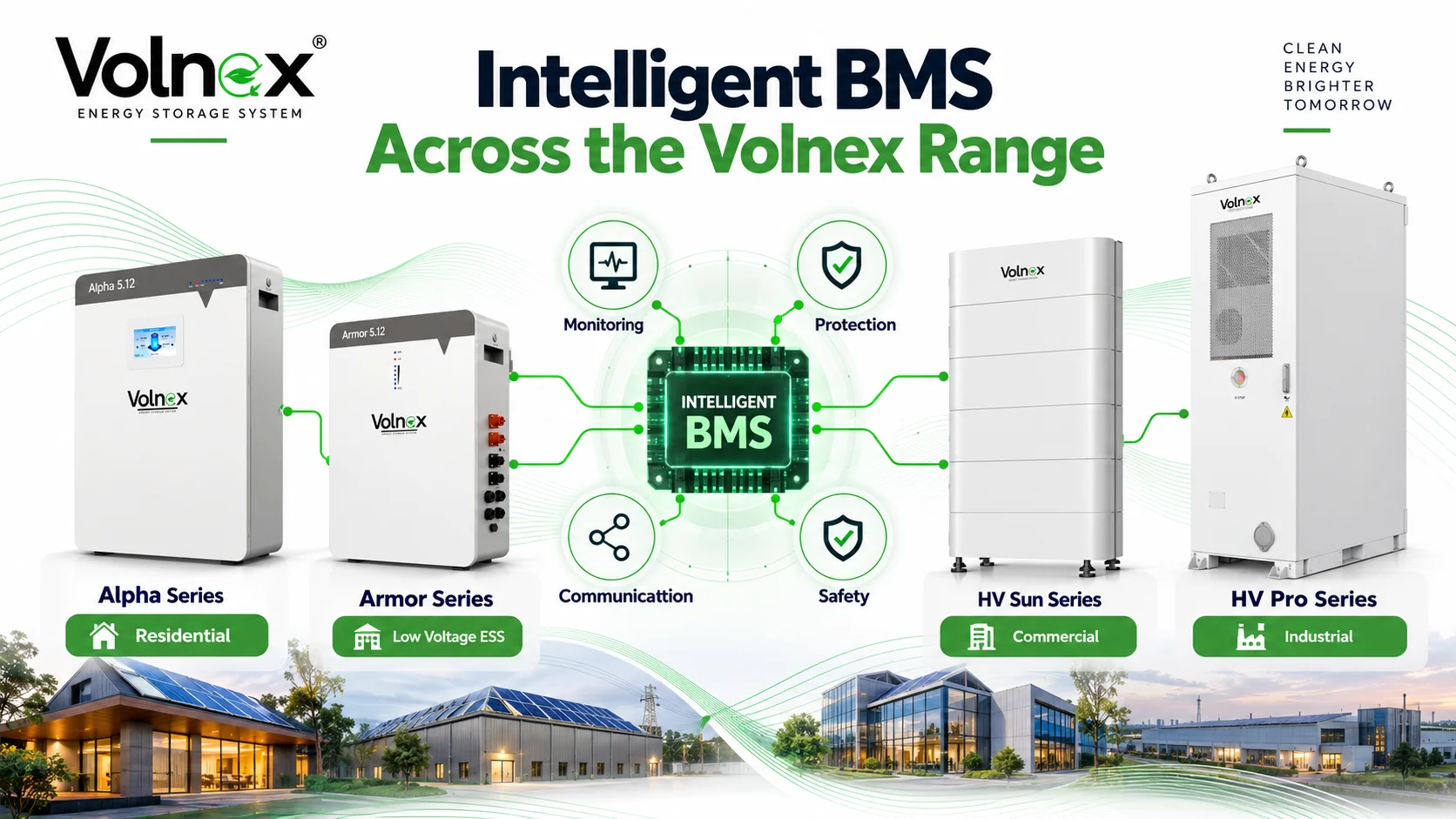
Alpha Series — Residential (Alpha 5.12, Alpha 10.49, Alpha 16)
Every Alpha battery includes:
- Real-time voltage, temperature, and SOC monitoring
- Auto aerosol fire suppression — an additional safety layer beyond the BMS itself
- Touch LCD display showing live battery data
- One-button start/stop with safe BMS-managed startup/shutdown sequences
- Parallel expansion coordination — up to 15 units for the Alpha 5.12
- CAN / RS485 / RS232 / Wi-Fi communication for full inverter and app integration
- Firmware update capability — the BMS management logic can be updated remotely
The Alpha 5.12’s cycle life rating of 6,000+ cycles at 90% DOD is a direct result of the BMS enforcing safe operating limits across every single charge/discharge cycle — day after day, year after year.
Armor Series — Armor 5.12
The Armor 5.12 is a low-voltage ESS sharing Volnex’s LFP foundation and intelligent BMS architecture, providing core voltage, temperature, and SOC protection.
HV Sun Series — Commercial (S7, S10, S14, S17, S21)
Volnex’s modular high-voltage HV Sun Series uses a BMS designed for larger installations:
- CAN / RS485 communication for commercial inverter integration (Kostal, GoodWe, Solis, Deye, Growatt, and others)
- Wi-Fi / app monitoring for real-time remote visibility
- Self-adaptation — the BMS auto-configures based on connected modules
- Multi-level alarms: overcharge, over discharge, overcurrent, overtemperature, short circuit
- Up to 12 towers connectable in parallel, with the BMS managing full inter-tower coordination
- 6,000+ cycle life under stated test conditions
- IP54 ingress protection for Pakistani outdoor installations
👉 See the full HV Sun Series →
HV Pro Series — Industrial (HV Pro 61-A)
Volnex’s industrial-grade system carries the most advanced BMS-integrated protection architecture in the lineup:
- CAN / RS485 / TCP enterprise-level communications
- Multi-layer fire suppression coordinated by the BMS: aerosol at module/stack level, combustible gas detection, water firefighting, and exhaust ventilation
- Multi-level safety alerts with remote monitoring and intelligent O&M
- Full operating range of -30°C to +55°C
- IP55 ingress protection
- 6,000 cycle life under stated test conditions
👉 See the full HV Pro Series →
Does a BMS Improve Battery Life?
Yes — significantly.
Every mechanism that shortens lithium battery life (overcharging, over-discharging, thermal stress, cell imbalance) is directly managed and prevented by an intelligent BMS.
Real-world data consistently shows that lithium batteries with a properly calibrated BMS last dramatically longer than batteries with a basic or absent BMS.
Volnex’s Alpha 5.12, for example, achieves 6,000+ cycles at 90% DOD — at one full cycle per day, that represents over 21 years of operation. That figure is only possible because the intelligent BMS enforces safe limits on every single cycle without exception.
How to Check If Your BMS Is Working
- Check the SOC display. A functioning BMS will show a stable, real-time state-of-charge reading on the battery LCD or monitoring app. A frozen or blank display can signal a BMS communication issue.
- Check for alarms or alerts. A working BMS surfaces protection events through its alarm system or the inverter’s display. No alarms after extended use generally means the BMS is operating normally.
- Verify inverter communication. If your inverter’s battery settings menu shows live battery data (SOC, voltage, state), the BMS communication link via CAN/RS485 is confirmed active.
- Monitor temperature readings. The BMS’s temperature sensors should be readable through the display or monitoring app. If temperature shows as “0” or “N/A” on a hot day, a sensor fault may be present.
If you suspect a BMS fault, do not continue operating the battery. Contact Volnex technical support immediately.
How to Reset a BMS
BMS reset procedures vary by product model. In general:
- Most Volnex batteries support a one-button start/stop that can reinitialize the BMS after a protection event
- For protection faults (overcharge, overtemperature), the BMS will automatically reset once the triggering condition is cleared — e.g., once the battery cools down or the voltage returns to a safe range
- If the BMS does not reset automatically after the fault condition is resolved, contact Volnex technical support for model-specific guidance
Do not attempt to manually bypass or reset a BMS without confirmed technical authorization — this can void warranty and create serious safety risks.
BMS vs No BMS — What’s the Real Risk?
| Scenario | With Intelligent BMS | Without BMS |
|---|---|---|
| Overcharge event | BMS cuts charge circuit automatically | Cells overheat, swell, or fail |
| Over-discharge | BMS cuts load before damage threshold | Permanent capacity loss |
| Temperature spike (45°C+ in Pakistan summer) | BMS throttles or pauses operation | Accelerated cell degradation |
| Cell imbalance over time | BMS balances cells continuously | Effective capacity drops steadily |
| Short circuit | BMS disconnects within milliseconds | Potential fire or explosion |
| 5-year expected life | Achievable with BMS protection | Often degraded to 50-60% capacity |
The BMS is not a luxury add-on. It is the difference between a battery that lasts 10+ years and one that fails in 2.
Related Guides
- What Battery Size Do I Need for My Home in Pakistan? — kWh sizing guide
- LFP vs Lead-Acid Batteries: Which Is Better for Solar in Pakistan? — chemistry comparison
- Low Voltage vs High Voltage ESS: Which Volnex Battery Is Right for You? — system architecture guide
Frequently Asked Questions
Q: What is a BMS system in a battery?
A: A BMS (Battery Management System) is an electronic circuit that monitors and protects a rechargeable battery by tracking voltage, current, and temperature in real time, enforcing safe operating limits, performing cell balancing, and communicating with the inverter or monitoring system.
Q: Does a BMS improve battery life?
A: Yes, significantly. By preventing overcharging, over-discharging, thermal stress, and cell imbalance, an intelligent BMS directly extends battery life. Volnex’s Alpha 5.12, for example, achieves 6,000+ cycles at 90% DOD — over 21 years at one cycle per day — enabled entirely by its intelligent BMS.
Q: How do I reset my BMS?
A: Most Volnex batteries reset automatically once the triggering fault condition is resolved (e.g., the battery cools down or returns to a safe voltage). If the BMS does not reset automatically, use the one-button start/stop function. For persistent faults, contact Volnex technical support — do not bypass the BMS manually.
Q: How to check if BMS is working?
A: Check the SOC reading on the LCD display, verify that your inverter is showing live battery data via CAN/RS485, confirm temperature readings are active, and check for any active protection alarms. If any of these are missing or frozen, contact Volnex technical support.
Q: What happens if a lithium battery has no BMS?
A: Without a BMS, a lithium battery is unprotected against overcharging, over-discharging, short circuits, and temperature extremes. This leads to rapid capacity loss, premature battery failure, and in severe cases, fire risk. Never purchase or install a lithium battery system without a certified BMS.
Q: Does every Volnex battery have a BMS?
A: Yes. Every Volnex product — Alpha Series, Armor Series, HV Sun Series, and HV Pro Series — includes an intelligent BMS as a core component of the battery system.
Q: What communication protocol does a Volnex BMS use?
A: Volnex batteries communicate via CAN and RS485 (all product lines), with Wi-Fi and app monitoring available on the HV Sun Series, and CAN / RS485 / TCP enterprise communications on the HV Pro 61-A.
Conclusion
The BMS is not a feature. It is the foundation of every safe, long-lasting solar battery.
Every Volnex battery — from the residential Alpha 5.12 to the industrial HV Pro 61-A — is built around an intelligent BMS that monitors, protects, and optimizes performance in real time, automatically, 24 hours a day.
In Pakistan’s load-shedding environment, extreme summer temperatures, and rapidly growing solar market, this protection is not optional. It is what separates a battery investment from a battery liability.
Ready to choose a solar battery with a proven intelligent BMS?
Browse the full Volnex product range at volnexpv.com/shop or get in touch directly:
📧 info@volnexpv.com
💬 WhatsApp Us
Volnex – The Brand Behind The Power. Established 2021, serving Pakistan with lithium energy storage solutions for residential, commercial, and industrial applications.